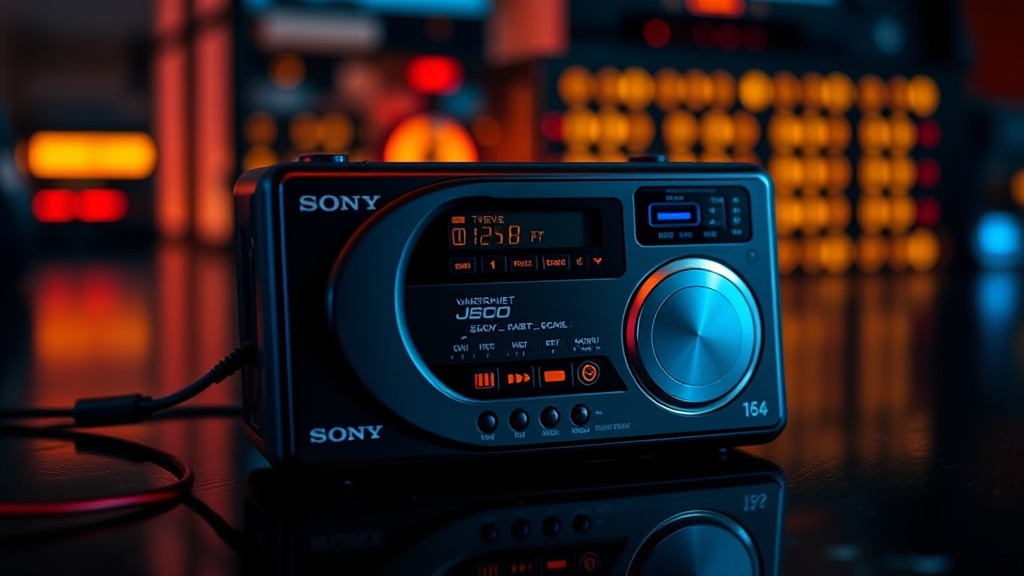
Unraveling the Walkman Code: What Sony's Model Numbers Really Tell You

What do Sony Walkman model numbers signify?
Understanding Sony Walkman model numbers might seem like a daunting task, but it’s an incredibly useful skill for any serious collector. These alphanumeric codes aren't just arbitrary identifiers; they’re a precise language, conveying vital information about a unit’s format, features, and even its intended market. Once you learn to interpret them, you'll gain a significant advantage in identifying authentic models, understanding their capabilities, and making informed decisions when adding to your collection.
Sony’s naming conventions, while sometimes appearing inconsistent over decades of innovation, generally follow a logical pattern. Most Walkman devices—whether cassette, CD, or MiniDisc—start with a prefix indicating their core technology. For instance, 'WM' almost exclusively denotes a Cassette Walkman. When you see 'D', you’re looking at a Discman, which is Sony’s branding for portable CD players, and 'MZ' points directly to a MiniDisc Walkman. This initial identifier is your first, fastest clue to a unit’s fundamental nature.
Beyond the primary format identifier, a series of letters and numbers further refines the description. These subsequent characters often represent specific features or a sub-series within the broader line. Take the WM series, for example: a 'WM-FX' model tells you it’s a Cassette Walkman (WM) with a built-in FM/AM radio tuner (F), offering extended features or a specific design iteration (X). A 'WM-EX' indicates an 'Extra' features model, often boasting superior sound quality, auto-reverse mechanisms, or advanced tape functions without a radio. These aren't hard and fast rules for every single model—Sony did experiment—but they hold true for a vast majority of their offerings.
Numbers within the model designation usually signify a chronological order or a tier of features. Higher numbers often, but not always, mean a newer model or one with more advanced capabilities. For instance, a WM-EX670 would generally be considered more advanced or from a later production run than a WM-EX500. However, don’t take this as gospel; sometimes a lower number denotes a premium, specialized model. You'll also encounter suffixes like 'G', 'L', 'S', or 'A' at the very end of a model number. These typically indicate regional variations, specific colorways, or minor package differences that don’t affect core functionality, but can certainly impact collectibility and rarity in certain markets.
Dissecting these codes takes practice, but it's a skill that pays dividends. It helps you quickly filter through listings, identify whether a unit genuinely possesses the features a seller claims, and prevents common pitfalls like mistaking a basic model for a premium one. It's about speaking Sony's language, allowing you to converse with confidence in the collector community and authenticate your finds with precision. Without this understanding, you’re often guessing, and that’s a risky proposition in the vintage audio market.
How can I decode specific Walkman series?
Once you grasp the general framework, diving into specific Walkman series reveals the true depth of Sony’s nomenclature. Each major product line—cassette, CD, MiniDisc—has its own family tree of sub-series, each with unique characteristics encapsulated in its model number. Let’s unpack some of the most sought-after and common series collectors encounter.
The Cassette Walkman (WM-series) is perhaps the most diverse. The 'WM-DD' series, for instance, represents Sony’s pinnacle of mechanical engineering in portable cassette players. 'DD' stands for 'Disc Drive,' referring to a direct drive motor mechanism that offered unparalleled playback stability and low wow and flutter. Models like the WM-DD9 or WM-D6C (the 'C' here denoting Dolby C noise reduction) are legendary, their model numbers hinting at their professional-grade aspirations. Then you have the 'WM-EX' and 'WM-FX' lines, which dominated the market through the late 80s and 90s. As mentioned, 'FX' denotes a radio tuner, while 'EX' means 'extra' features—often including advanced auto-reverse, long battery life, and sleeker designs. For example, a WM-EX909 is a highly regarded 'EX' model known for its slim profile and comprehensive features, while a WM-FX808 represents a high-end radio-equipped counterpart.
Moving to digital, the Discman (D-series) portable CD players followed a similar pattern. Early models like the D-50 were revolutionary for their compactness. As the series evolved, numbers usually climbed, signifying improvements in anti-skip protection (ESP, or Electronic Shock Protection), battery life, and remote control integration. You’ll find 'D-E' models, often indicating standard consumer CD players, and 'D-FJ' or 'D-NF' models, where 'F' suggests a radio tuner and 'N' often points to network capabilities for digital audio files or advanced features. For instance, a D-EJ1000 represented a very slim, premium Discman, whereas a D-NF430 would be a feature-rich model with radio and MP3 playback capabilities. The letter following the 'D' and the subsequent numbers are your keys to understanding their position in Sony’s product hierarchy.
The MiniDisc Walkman (MZ-series) also offers a clear path through its model numbers. 'MZ-R' models are recorders, allowing you to both play and record MiniDiscs. The 'R' is your immediate clue. 'MZ-E' models are players only, focusing on playback portability and battery efficiency. Later, 'MZ-N' models introduced 'NetMD' functionality, enabling faster digital audio transfer from computers—a significant upgrade for many users. So, an MZ-R900 is a top-tier recorder, while an MZ-E707 is a playback-focused unit. An MZ-N10, then, would be a premium NetMD recorder. This distinction between recording and playback, and the integration of PC connectivity, forms the backbone of the MiniDisc model numbering system.
Understanding these specific series helps you distinguish between common finds and truly special pieces. It means you can look at a listing for a 'Sony WM-EX655' and immediately know you’re assessing a cassette player with advanced playback features, likely auto-reverse and excellent sound, without a radio. This level of insight transforms you from a casual browser into a discerning collector, capable of making precise evaluations about potential acquisitions.
Where can I find reliable Walkman model information?
Armed with a foundational understanding of Sony’s model number logic, the next step is knowing where to turn for comprehensive, reliable information. The internet is a vast repository, but quality varies wildly. For accurate specifications, historical context, and even service manuals, there are a few go-to sources that seasoned collectors rely on.
One of the most authoritative resources for vintage Sony Walkman information is