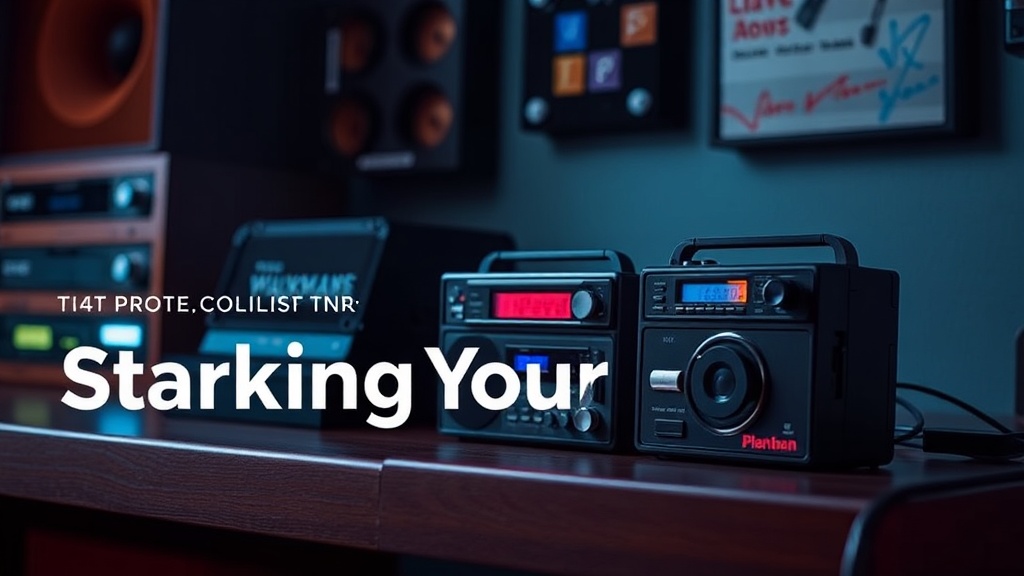
The Complete Guide to Starting Your Walkman Collection

Starting a Walkman collection offers a tangible connection to music history—portable audio changed how people experienced albums, mixtapes, and radio on the move. This guide covers everything needed to begin: understanding the different models, knowing what to look for when buying, budgeting realistically, and avoiding common pitfalls that catch new collectors off guard. Whether drawn to the nostalgia of cassette culture or the engineering of vintage Sony hardware, there's a clear path to building a collection worth owning.
What Walkman Models Should Beginners Look For First?
The best starting points are reliable, well-documented models that won't drain the wallet. Sony's WM series from the mid-1980s to early 1990s hits the sweet spot—common enough to find, repairable when they break, and sonically satisfying.
The Sony WM-D6C sits at the top of many want lists. It's a professional-grade portable recorder—essentially a field-ready version of the famous Nakamichi decks. The D6C fetches premium prices ($400–$800 depending on condition), but it plays cassettes with fidelity that rivals home hi-fi equipment. Worth noting: this model is overkill for casual listening, and the complicated mechanism demands maintenance skills (or a trusted repair person).
For everyday enjoyment, the Sony WM-10 and WM-20 series offer compact designs that still turn heads. These "micro" Walkmans run on a single AA battery and slip into any pocket. Sound quality won't match the D6C, but the convenience factor is undeniable. Expect to pay $80–$200 for working units with clean battery compartments.
The Sony WM-FX290 and similar radio-cassette combos from the 1990s represent the budget tier. These were mass-produced, so they're plentiful on eBay and at thrift stores. Prices range from $30–$80. The catch? Plastic construction feels cheap, and the mechanisms wear faster than metal-chassis models from the 1980s.
| Model | Type | Price Range (USD) | Best For |
|---|---|---|---|
| Sony WM-D6C | Professional recorder/player | $400–$800 | Audiophiles, recording enthusiasts |
| Sony WM-10/WM-20 | Ultra-compact player | $80–$200 | Portability, casual listening |
| Sony WM-FX290 | Radio/cassette combo | $30–$80 | Budget builds, beginners |
| Aiwa HS-JX810 | Feature-rich player | $150–$350 | Remote control, auto-reverse |
Don't overlook Aiwa. The HS-JX series—particularly the JX810 and JX919—packed features Sony reserved for higher price brackets: wireless remotes, full-logic controls, and Dolby B/C noise reduction. Aiwa built these to compete directly with Sony's premium lines, and many collectors argue they sound better. Parts are harder to source though, so factor that risk into any purchase.
How Much Should You Budget for a Starter Collection?
A functional, varied collection starts around $300–$500. That buys three to five solid players in different categories—perhaps a compact daily driver, a radio-equipped model for variety, and one "grail" piece that represents the pinnacle of the format.
Here's how costs typically break down for new collectors:
- Entry-level players (Sony WM-EX series, basic Aiwa models): $40–$100 each. These are working units with cosmetic wear—scratches, faded labels, maybe a loose battery door. They play tapes reliably.
- Mid-tier collectors' pieces (WM-10, WM-20, Aiwa HS-JX): $100–$250. Better condition, complete with original accessories, fully functional belts and capacitors.
- Flagship/enthusiast models (WM-D6C, WM-EX1, MZ-RH1): $300–$800+. These are the conversation pieces. The MZ-RH1 is actually a MiniDisc recorder—but it's the device that lets users archive cassettes digitally, making it indispensable for serious preservation work.
Beyond hardware, budget for media. New-old-stock Maxell XLII or TDK SA cassettes command $10–$25 per tape on the secondary market. Type II (CrO2) and Type IV (metal) formulations sound noticeably better than Type I, but they require players with proper bias settings. Most Walkmans handle Type I just fine—that's your baseline.
The real budget killer? Shipping and import fees. Walkmans often ship from Japan (excellent condition, original boxes) or Europe (different radio tuners, sometimes rare colorways). A $150 player becomes $220 after international shipping and customs. The workaround: buy from domestic sellers when possible, or bundle multiple units in one shipment to spread costs.
Repairs add up fast. A simple belt replacement runs $30–$60 if outsourced. Capacitor recapping on a complex model like the D6C? $150–$300. Learning basic maintenance—cleaning heads, replacing belts, adjusting speed—saves hundreds over a collection's lifetime. YouTube channels like The 8-Bit Guy demonstrate these techniques without the gatekeeping found in some collector forums.
Where Do Walkman Collectors Actually Find These Units?
eBay remains the dominant marketplace, though it's a minefield of inflated "vintage" pricing and untested listings. Search terms matter: "Walkman tested working" filters out the worst listings, while "junk" or "for parts" finds repairable units at steep discounts. Japanese sellers (often marked "JP" or shipping from Osaka/Tokyo) typically grade conservatively—a "good condition" unit from Japan usually beats an "excellent" from elsewhere.
Facebook Marketplace and Craigslist reward patience. Sellers who don't know what they have price units at $20–$40. The flip side: no returns, no testing guarantees, and often corroded battery compartments from years in storage. Always ask for a video of the unit playing—watch the tape counter advance smoothly.
Estate sales and thrift stores are lottery tickets. Most days yield nothing. But occasionally, a pristine Sony WM-F107 (the solar-powered waterproof model) surfaces for $5 because the deceased owner's children see "old radio" rather than "collectible electronics." These moments justify hundreds of fruitless visits.
Specialized forums and Discord servers run sales threads with vetted members. The r/cassetteculture community hosts monthly marketplace posts. Prices trend higher than eBay, but sellers disclose known issues honestly—something rare on auction sites. Reputation matters in tight-knit collecting circles.
Auction houses occasionally feature high-end Walkmans in electronics or "future primitive" sales. Heritage Auctions sold a sealed WM-D6C for $4,200 in 2023. That's extreme—but it signals where the market heads for untouched, documented specimens.
Red Flags to Avoid
Some problems aren't worth fixing, even for the mechanically inclined. Here's what kills deals:
- Missing battery doors: Replacement 3D-printed doors exist, but they look wrong and fit poorly. OEM doors from donor units cost $30–$50—often more than the player itself.
- Detached tape counters: The thin string that drives mechanical counters breaks easily. Re-stringing requires patience and the right diameter cord. Not impossible, but annoying.
- Personal engravings: "Property of Mike, 1987" carved into the back panel destroys resale value. These marks don't buff out without aggressive sanding that ruins anodized finishes.
- Unknown storage history: Units stored in attics or garages face temperature extremes that warp belts and fry capacitors. Ask where it lived.
Building Your First System
Start with one reliable player and a small tape collection. Don't accumulate hardware faster than media—empty shelves of non-functional Walkmans help nobody. The Sony WM-EX511 or WM-EX621 from the early 2000s offer metal mechanisms, Mega Bass, and reasonable prices ($60–$120). They're new enough that belts often still work, old enough to feel authentic.
Add a Maxell 90-minute Type I tape for testing—long enough to check wow and flutter over extended playback, cheap enough to discard if the deck eats it. Record something with piano or solo voice (complex waveforms reveal speed instability). If the piano doesn't waver, the capstan motor and belt are healthy.
From there, specialization beckons. Some collectors chase Sony's ultra-thin "EX" series—machines like the WM-EX1 that measured just over a centimeter thick. Others prefer the ruggedness of sports models: the WM-F75 with its splash resistance, or the WM-F35 "Sports Walkman" in garish yellow. There's no wrong path—only the one that resonates with how you want to experience portable audio.
The community rewards curiosity. Fredericton's vintage audio scene—while modest—hosts the occasional swap meet where cassettes trade hands alongside stories of concerts recorded off FM radio decades ago. Online, collectors share restoration photos, capacitor replacement guides, and rumors of warehouse finds. The hunt never truly ends. That's the point.
"A Walkman isn't just a player—it's a time machine with a headphone jack. The right model doesn't just play tapes; it transports you to the moment that album first mattered."
Ready to start? Pick a budget, choose a model that speaks to your priorities (sound quality? portability? features?), and buy from a seller who accepts returns. Test everything immediately. Document what works and what doesn't. The knowledge compounds faster than the hardware—and that's where collecting becomes genuinely rewarding.